Convection vs Conventional Oven, How to Adjust the Temperature
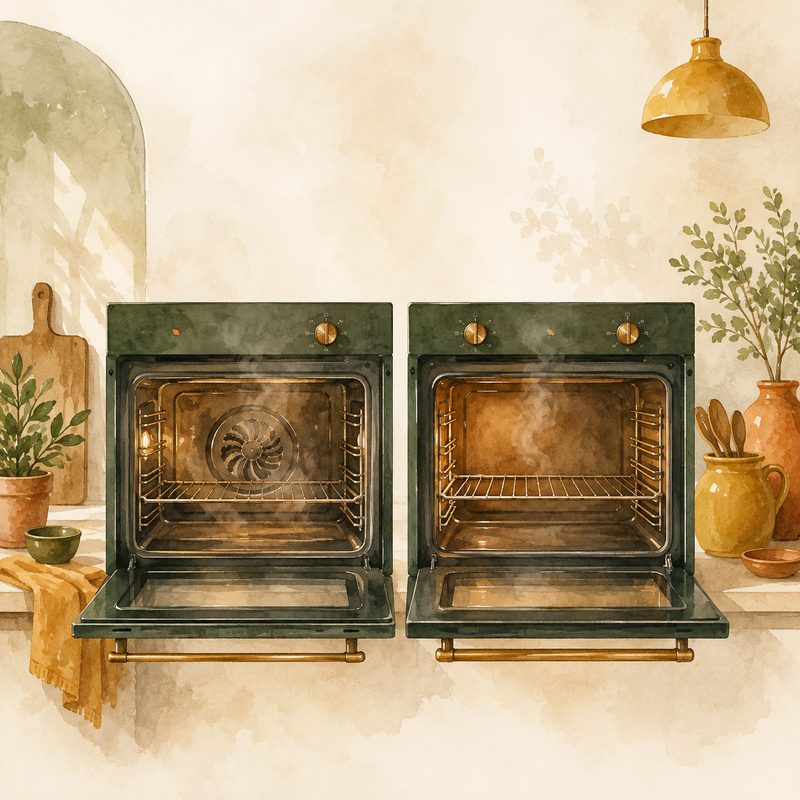
When switching from a conventional oven to a convection oven (fan-assisted), lower the temperature by about 20°C from what the recipe states — or keep the same temperature and instead cut the baking time by about 25%.
Why convection bakes faster
A convection oven uses a fan to continuously circulate hot air around the food. That circulation eliminates the pockets of stagnant air and the temperature differences between the top, bottom, and sides of the oven that show up in a conventional one. The result: heat reaches the surface of the food more efficiently, which speeds up baking and promotes more even browning, without needing to rotate pans halfway through.
Two ways to adjust, not both at once
There are two equivalent ways to compensate for this faster cooking:
- Lower the temperature by about 20°C (or 25°F) and keep the baking time stated in the recipe.
- Keep the original temperature and start checking for doneness about 25% earlier than the stated time.
Pick one or the other, never both together — combining a lower temperature with a shorter time risks undercooking the inside. Many recent convection ovens offer an automatic setting (often called "convection conversion" or "auto-adjust") that already adjusts the temperature for you: check your appliance's manual before doing the math yourself.
When convection really changes the result
Convection mode excels at roasting vegetables or meat, baking several trays of cookies at once without rotating them, or getting nicely crisp chicken skin. It's less suited, though, to delicate preparations that depend on a gentle, even rise in heat — soufflés, custards, quiches, or quick breads — where the fan's airflow can disrupt rising or dry out the surface before the inside finishes cooking. For these recipes, conventional mode (no fan) often remains preferable, even if your oven offers convection.
Telling which mode your oven is in
On most ovens, convection mode is marked by a fan icon, either alone (pure fan-forced) or inside a circle (convection with a ring element). Conventional mode is shown as two horizontal lines — top and bottom elements — with no fan. An oven that audibly blows during baking is in convection. Many recent North American ovens also have a "convection bake" and a "convection roast" mode: the first reduces fan power for baking, the second increases it for meat and vegetables. If the manual is long gone, a search with the model number usually gives the answer.
The recipes where you should turn the fan off
Some preparations fail almost every time in convection, whatever the temperature: macarons, whose feet form crooked under the airflow; meringues and pavlovas, which crack and brown; soufflés, which rise unevenly; cheesecakes, whose surface splits; sponge cakes and angel food cakes, very airy, which dry out on the surface before they've risen. For these recipes, switch to conventional mode even if your oven can do convection — and keep the original temperature without lowering it by 20°C, since the adjustment no longer applies.
Quick reference
An American recipe that calls for 350°F (177°C) conventional becomes about 330°F (166°C) in convection — or stays at 350°F if you'd rather adjust the time instead of the temperature. That same 20°C reduction applies at any setting: 400°F becomes about 380°F, 425°F about 405°F.
The advantage for multi-rack baking
One of convection's big advantages: it lets you bake two or three trays of cookies at once, on different racks, without having to rotate them halfway through the way you do in conventional mode. Since hot air circulates evenly throughout the oven, each tray gets comparable heat, saving valuable time when baking in bulk.
Preheating is faster too
A convection oven generally reaches its target temperature faster than a conventional one, thanks to the air circulation that distributes heat more efficiently right from the start. Don't rely solely on the preheat beep: just as with a conventional oven, allow a few extra minutes for the temperature to truly stabilize before putting your dish in, especially for baking that's sensitive to heat fluctuations.
For recipes that already specify "convection oven" in their original instructions, no adjustment is needed — the stated temperature is already designed for that mode, unlike a generic recipe that assumes a conventional oven by default.
Forgetting convection mode ranks high among the most common baking conversion mistakes — useful for diagnosing a failed recipe despite a correct temperature.