How Many Grams Are in a Cup of Powdered Sugar?
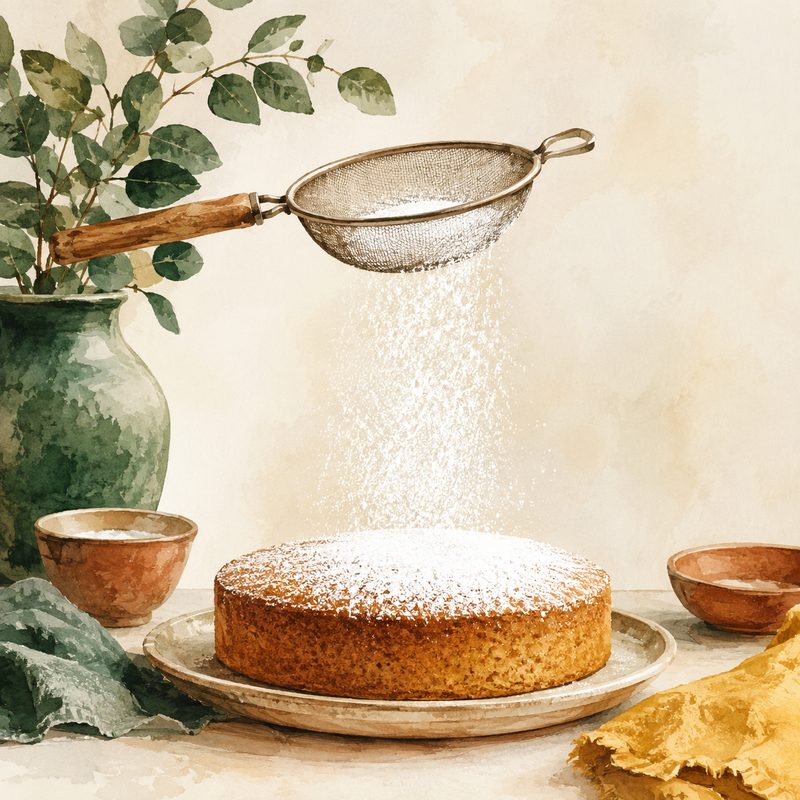
A cup of powdered sugar (icing sugar or confectioners' sugar) weighs about 120 g — nearly half as much as a cup of granulated white sugar, which weighs 200 g.
Why it's so light
Powdered sugar is white sugar ground into a very fine powder, with a small amount of cornstarch added to keep it from clumping into a damp block. Its composition is therefore nearly identical to granulated sugar's — but its ultra-fine, powdery texture traps far more air between the particles. For the same volume, there's simply much less actual sugar in the cup, hence the noticeably lower weight.
Sift before measuring
Powdered sugar compacts easily during transport and storage — a bag that's been handled can already be more packed down than it was at purchase. To stay close to the 120 g reference, spoon it into the cup without packing it, then level off with a knife, exactly as you would with flour. Avoid dipping the cup straight into the bag, which compacts the sugar and can inflate the measured weight by 15 to 20%.
Why weight matters more than volume for frosting
A frosting's consistency is very sensitive to the exact amount of powdered sugar: too much makes it thick and grainy, too little makes it too runny to hold on a cake. Because this sugar packs down easily, two "by the cup" measurements from two different people can produce noticeably different results — a scale eliminates that problem.
Quick reference
- 1 cup = 120 g
- ¾ cup = 90 g
- ½ cup = 60 g
- ¼ cup = 30 g
- 1 tbsp ≈ 7 g
If your frosting recipe calls for 2 cups of powdered sugar and the result comes out too runny, before adding more at random, check whether your first measurement was accidentally packed — that's often the real cause.
The ratio of a classic buttercream
The basic American recipe for a simple buttercream: 1 stick of butter (½ cup, 113 g) to 2 cups of powdered sugar (240 g), with a tablespoon or two of milk and a little vanilla. In other words, about twice the weight of the butter in sugar. That ratio is enough to frost a dozen cupcakes or a 20 cm cake without excess. For a firmer frosting meant to be piped into decorations that hold, recipes go up to 3 cups (360 g) for the same stick; for a lighter one, they drop to 1 ½ cups (180 g).
If the volume seems enormous — 2 cups of sugar for half a stick of butter — remember that powdered sugar is very airy: 240 g of powdered sugar takes up twice the volume of 240 g of white sugar. It's the weight that matters for texture, not the visual impression in the cup.
Powdered sugar, icing sugar, confectioners' sugar: the same product
Depending on the country, the same ingredient changes name: "powdered sugar" or "confectioners' sugar" in the US, "icing sugar" in the UK and English Canada, "sucre à glacer" in Québec, "sucre glace" in France. American packaging sometimes says "10X," which simply indicates the fineness of the grind. All are measured with the same 120 g per cup reference. Watch out, though, for the French "sucre en poudre," which means ordinary granulated white sugar (200 g per cup) and not icing sugar — a mix-up that throws a recipe off by a factor of nearly two.
Making your own powdered sugar
If you're out of powdered sugar, a food processor or coffee grinder can turn granulated white sugar into a fine powder in one to two minutes. The result won't have the perfectly smooth texture of commercial powdered sugar (which contains a bit of anti-caking cornstarch), but its weight per cup stays very close to the 120 g reference — handy in a pinch for a frosting or for dusting a dessert.
Powdered sugar and humidity
This sugar readily absorbs ambient moisture, especially in a kitchen where the air carries cooking steam. Damp powdered sugar packs down more and can weigh noticeably more than the 120 g reference for the same cup — a good sign the container wasn't sealed tightly enough. Store it in a closed container away from moisture to keep your measurements consistent from one time to the next.
Finally, if a recipe specifies "sifted powdered sugar" at the top of the ingredient list, sift before measuring, not just before folding it in — the order slightly changes the volume you get for the same weight.
And if an American recipe lists powdered sugar in cups with no other note, assume it's unpacked, unlike brown sugar — that's the default convention for this type of sugar in nearly all North American recipes.
Mixing up powdered sugar, caster sugar, and white sugar is one of the most common baking conversion mistakes — that article details the other traps of the same kind.