How Many Grams Are in a Cup of Sugar?
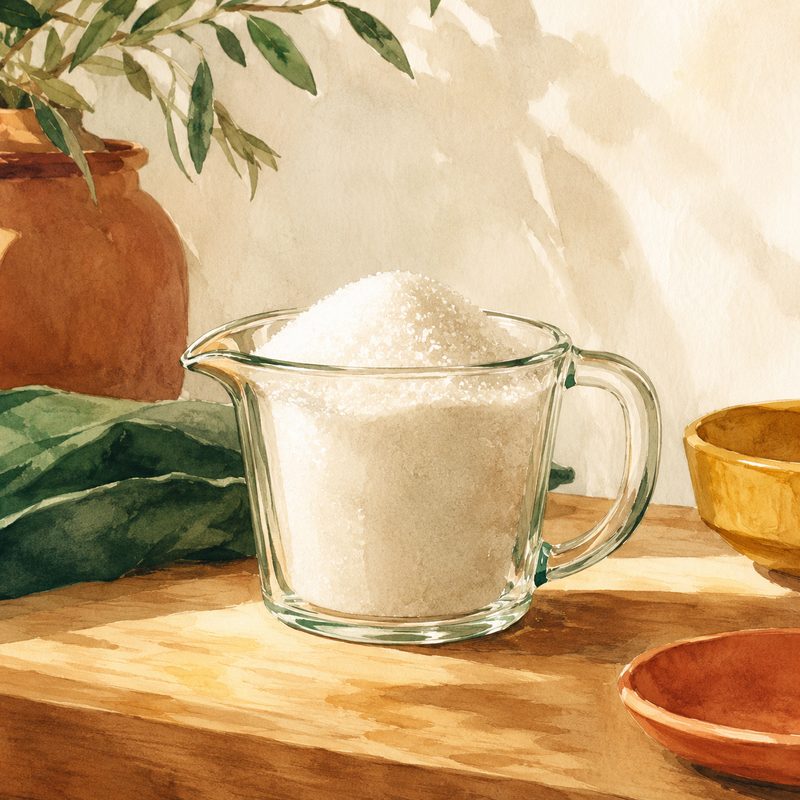
A cup (250 ml) of granulated white sugar weighs about 200 g. That's the short answer. What follows explains why this number shifts depending on the type of sugar you're using.
Not all sugars weigh the same
White sugar, brown sugar, and powdered sugar all share the same measuring unit at the store — the cup — but not the same density. As a result, for the same volume, their weight differs noticeably:
- 1 cup of granulated white sugar = 200 g
- 1 cup of packed brown sugar = 220 g
- 1 cup of powdered sugar = 120 g
Brown sugar weighs more because it's usually packed into the measuring cup — its sticky crystals compress and leave less air between them. Powdered sugar, by contrast, is very airy: its ultra-fine particles, almost like flour, trap a lot of air, so the same volume contains less actual matter.
Why you can't just multiply by water's density
The "1 cup = 250 ml = 250 g" shortcut only works for water. White sugar has a density of about 0.80 — it weighs 80% of the same volume of water. That's why 250 ml of sugar comes out to 200 g, not 250 g. Every ingredient has its own density, and that's what makes all the difference between a recipe that works and a mix that's too dry or too runny.
The trap of the word "packed"
A recipe that specifies "1 cup packed brown sugar" expects you to press the sugar into the cup until it holds the shape of the container once turned out. Without that packing, the same volume can weigh 15 to 20% less — the sugar simply looks lighter because it holds more air. On the other hand, no one ever packs white sugar or powdered sugar: they're measured as-is, spooned into the cup.
Cheat sheet for cup fractions
If your recipe calls for a fraction of a cup of white sugar, here are the gram equivalents:
- 1 cup = 200 g
- ¾ cup = 150 g
- ½ cup = 100 g
- ⅓ cup = 67 g
- ¼ cup = 50 g
- 1 tbsp = 12 g
For brown sugar or powdered sugar, keep the 220 g and 120 g per-cup figures in mind, and scale proportionally for fractions.
A kitchen scale remains the most reliable option, especially for brown sugar, where how firmly you pack it can easily swing the result by 10 to 15%. If all you have is a measuring cup, add the sugar without over-packing and level off with a knife to stay close to the figures above. And if an American recipe mixes both — white sugar in cups and brown sugar in grams in the same paragraph — weigh both rather than guessing: the density gap between the two sugars is exactly what makes eyeballed conversions unreliable.
Sugar by the spoon, for small amounts
For recipes that measure sugar by the spoon — whipped cream, a vinaigrette, a light syrup — the same densities give: 1 tbsp of white sugar = 12 g, 1 tsp = 4 g. For packed brown sugar, count 13 g per tablespoon; for powdered sugar, 7 g. A restaurant sugar packet holds roughly one teaspoon.
Cutting the sugar in a recipe: how far can you go?
Many people reduce the sugar in American recipes, often considered very sweet. It's doable, but sugar isn't only a sweetener: it holds moisture, helps cookies spread, promotes browning, and softens the crumb. Cutting by 25% generally goes unnoticed in a cake, a muffin, or a quick bread. Beyond a third, the texture changes: paler, cakier cookies, a drier cake that goes stale faster, a meringue that won't hold. For recipes where sugar plays a structural role — meringues, caramel, jams — leave the quantities alone.
If you do reduce, do it by weight rather than volume, and note the exact amount so you can adjust next time.
What about caster sugar?
Some American recipes call for "caster sugar" or "superfine sugar," a sugar with finer crystals than regular granulated sugar but coarser than powdered sugar. Its density stays very close to ordinary white sugar's — about 200 g per cup as well — so if you can't find any, regular white sugar pulsed for a few seconds in a food processor works just fine, without changing the quantity called for in the recipe.
White sugar, brown sugar, powdered sugar, and nine other ingredients: the complete conversion chart gives the weight of every cup fraction on one page.