1 Pound of Butter: How Many Sticks Is That?
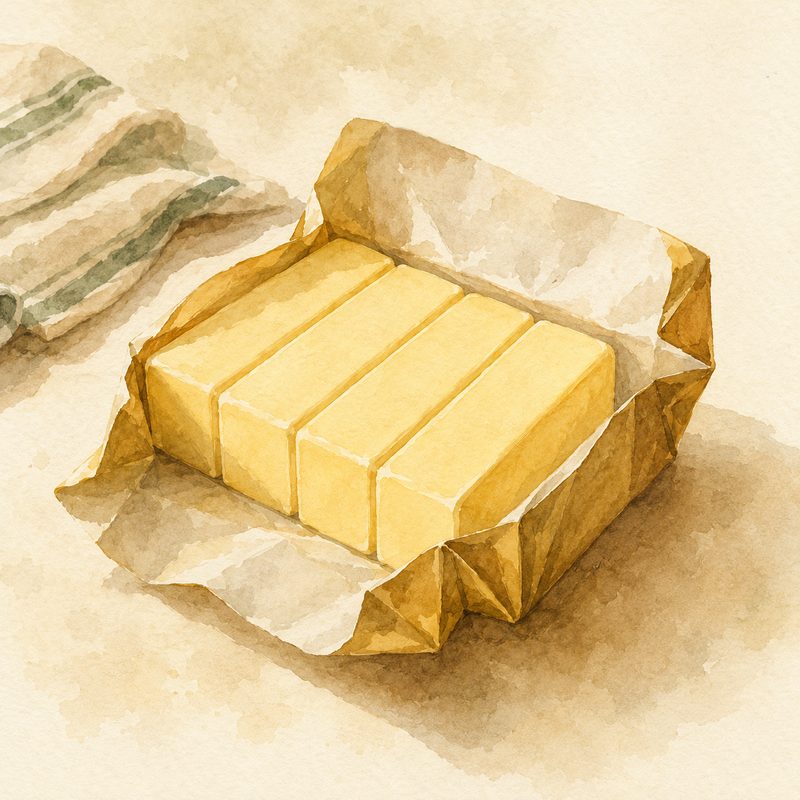
A pound of American butter is 4 sticks. Each stick weighs about 113 to 114 g, so four of them add up to 453-454 g — exactly one pound.
The math
A pound equals 453.6 g. A stick, meanwhile, is half a cup of butter (125 ml), which comes out to about 114 g once you multiply by butter's density (0.91):
453.6 g ÷ 114 g ≈ 3.98, rounded to 4 sticks
That's actually why American butter is sold in boxes of four sticks — each box lines up precisely with one pound, a format designed from the start to land on a round number.
Why this matters
Plenty of American recipes list butter in sticks rather than grams or cups, especially for larger quantities: "1 lb of butter" in a butter tart or fudge recipe simply means 4 sticks, ready to unwrap without needing to measure anything.
Quick reference
- 1 lb of butter = 4 sticks ≈ 454 g
- ½ lb of butter = 2 sticks ≈ 227 g
- ¼ lb of butter = 1 stick ≈ 113-114 g
- ⅛ lb of butter = ½ stick ≈ 57 g
Cutting a stick without a scale, thanks to the wrapper
The paper around each American stick is printed with markings: eight lines, one per tablespoon. That's what lets American recipes write "6 tbsp butter" without anyone reaching for a scale — you cut at the sixth line. A whole stick is 8 tbsp, half a pound is 16, a pound is 32. Each tablespoon of butter weighs about 14 g, which lets you convert any such instruction back to grams: "5 tbsp" = 5 × 14 = about 70 g.
If you buy butter in a 250 g or 454 g block with no markings, the simplest approach is to cut the 454 g block lengthwise into four equal parts: each quarter is a stick. A 250 g block is a little more than two sticks (2.2, exactly) — cut it in half for two slightly generous sticks, or weigh if the recipe is precise.
Butter in "cups" in recipes
Many American recipes write neither lb nor sticks but cups: "1 cup butter," "½ cup butter." The correspondence is simple because sticks were sized for it: a stick is half a cup, so 1 cup of butter = 2 sticks ≈ 227 g, and ¼ cup = ½ stick ≈ 57 g. A whole pound is 2 cups. Our converter applies butter's density (0.91) to go from a volume in cups to a weight in grams, which yields the same figures.
What if your recipe says "box" instead of "lb"?
Some American recipes reference the purchase format directly, like "1 box of butter," which almost always means one pound (4 sticks) — the standard package size at American grocery stores. Unless stated otherwise, a North American box of butter is generally 454 g.
For recipes that mix both systems — part in sticks, part in grams or cups — the simplest approach is to convert everything to grams up front: it's the most precise unit and the only one that removes all ambiguity between measurement formats.
Salted or unsalted: the weight doesn't change
Whether the stick is salted or unsalted butter, its weight stays the same — salt doesn't meaningfully change the density. Most American baking recipes default to "unsalted butter" specifically so the baker keeps full control over how much salt gets added separately. If your recipe doesn't specify, unsalted remains the safer choice.
And if your recipe is written entirely in grams rather than sticks — increasingly common even in American recipes aimed at an international audience — you can skip this conversion entirely and just weigh out the amount given, without ever needing to know how many sticks it represents.
Finally, keep in mind that this "4 sticks per pound" reference is specific to American butter — other block-sold fats, like shortening, don't necessarily follow the same stick divisions or weight per unit, even if the packaging looks similar.
One last visual cue: a standard box of butter is roughly the length of a hand and cuts easily into four — handy for eyeballing a single stick without pulling out the scale every time.
To find butter — along with flour, sugar, and oven temperatures — at a glance, the complete conversion chart gathers every reference on the site on a single page.