How Much Is a Pinch of Salt, Exactly?
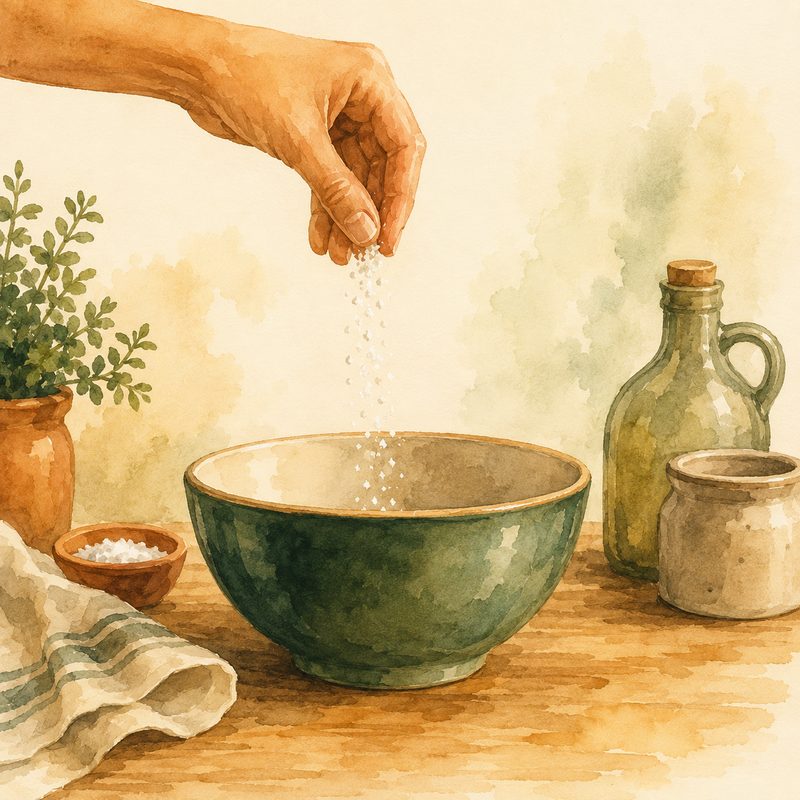
A pinch of salt has no strict official definition — that's exactly the problem. The most common reference point: about 1/16 teaspoon, which weighs roughly 0.4 g, or what fits between your thumb and index finger.
A deliberately fuzzy measurement
Unlike the tablespoon or teaspoon, the "pinch" was never standardized by any official body — it comes from a gesture, not an instrument. That's why culinary sources don't fully agree: some treat it as 1/16 teaspoon, others as 1/8. The difference sounds small, but it doubles the actual amount depending on which definition you use.
What that comes out to in grams
Salt has a density of about 1.20. Applying the two most common definitions:
- 1/16 tsp of salt ≈ 0.3 ml × 1.20 ≈ 0.4 g
- 1/8 tsp of salt (sometimes called a "generous pinch" or confused with a "dash") ≈ 0.6 ml × 1.20 ≈ 0.75 g
For reference, a full teaspoon of salt weighs about 6 g — so a pinch represents somewhere between 6% and 12% of that amount, depending on which definition you go with.
Pinch vs. dash
Some American recipes distinguish a "pinch" from a "dash," with the dash generally being a bit more generous — closer to 1/8 teaspoon for a dry ingredient like salt, or a few drops for a liquid like hot sauce. The distinction stays informal and varies from one cookbook to the next; don't treat it as a strict boundary.
Table salt, sea salt, kosher salt: one pinch isn't the other
The 0.4 g calculated above is for fine table salt, whose density (1.20) is the one our converter uses. Kosher salt, very common in American recipes, comes in flakes or irregular coarse crystals that leave a lot of air between them: for the same volume, there's noticeably less salt than with fine salt. A pinch of kosher salt is therefore less salty than a pinch of fine salt, and the same goes for coarse sea salt.
That's one reason an American recipe can taste "too salty" once remade with fine salt: the author measured kosher salt by volume, and you used the same spoonful of much denser fine salt. When a recipe specifies "kosher salt" and you don't have any, cut the amount of fine salt by about a third to a half, then taste.
Why there's salt in a sweet cake
Almost every American baking recipe calls for a pinch or half a teaspoon of salt, even in a chocolate cake or cookies. It's not to make them taste salty: in small doses, salt heightens the perception of sugar and aromas (vanilla, chocolate, butter) and rounds off bitterness. A batter without salt tastes flat. So don't skip that pinch on the grounds that the recipe is sweet — and don't double it either, the effect shows up quickly in the other direction.
When the precision of a pinch actually matters
For final seasoning — adjusting taste at the end of cooking — the imprecision of a pinch is a non-issue: you taste and adjust. It's different in baking, where salt plays a chemical role beyond flavor, particularly in gluten development and balancing sweetness. In a baking recipe that calls for "a pinch of salt," a small measuring spoon graduated in 1/8 or 1/16 teaspoon removes the guesswork — a cheap accessory if you bake precise American recipes often.
Other pinches, other spices
The same approximate measuring principle applies to other powdered spices — pepper, nutmeg, cinnamon — but their density differs from salt's, so the exact weight of a pinch varies by ingredient even when the volume looks comparable. For these spices, the gesture matters more than the number: what counts is consistency from one time to the next, not absolute precision to the tenth of a gram.
If an American recipe stacks up several pinches — "a pinch of salt, a pinch of pepper, a pinch of cayenne" — don't try to convert each one to the milligram: taste as you go and adjust, which is exactly the spirit these quantities were written in to begin with.
Salt is just one case among others: abbreviation mix-ups (tsp/tbsp) and packing errors come up in the most common baking conversion mistakes.