How Many Grams Is a Stick of Butter?
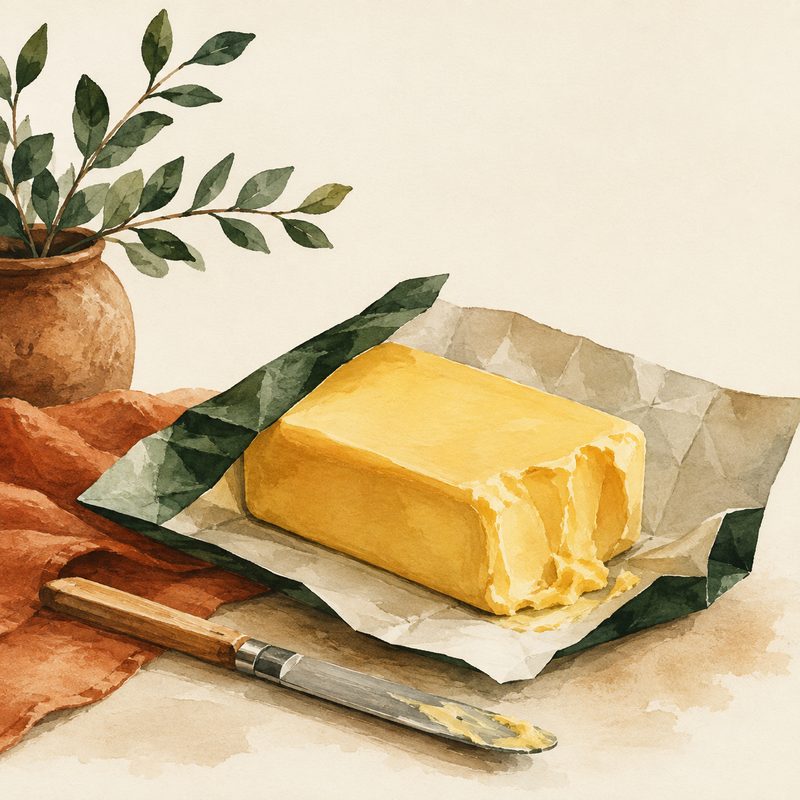
An American stick of butter weighs about 113 to 114 g. That's half a cup of butter (125 ml), or 8 tablespoons.
Where this measurement comes from
In the US, butter is sold in rectangular blocks called "sticks," packaged four to a one-pound box (454 g). Each stick is therefore a quarter pound, or about 113 g. The wrapper usually has tablespoon markings printed right on the paper, letting you cut off the amount a recipe calls for without a scale — a whole stick equals 8 tbsp of butter, a convention almost absent from French or Québécois recipes, where butter is sold in 250 g or 454 g blocks with no cutting guides.
The detailed math
By volume, a stick equals half a cup, or 125 ml. Butter has a density of about 0.91 (it's slightly lighter than water, thanks to its fat content and the air worked in during churning):
125 ml × 0.91 ≈ 114 g
That result lines up with the 113 g commonly cited for a stick — the one-gram gap simply comes from rounding between the official American measurement and the density used in the calculation.
Quick reference for your recipes
- 1 stick = ½ cup = 8 tbsp ≈ 113-114 g
- ½ stick = ¼ cup = 4 tbsp ≈ 57 g
- ¼ stick = 2 tbsp ≈ 28 g
- 2 sticks = 1 cup = about 227 g
- 4 sticks = 1 lb ≈ 454 g
- 1 tbsp of butter ≈ 14 g
If a recipe calls for "½ stick," no need to reach for a calculator every time: that's 4 tbsp, or about 57 g. And if it calls for "6 tbsp butter" with no mention of sticks, that's three quarters of a stick, or about 85 g.
Only have a scale, no measuring cup?
That's actually the more precise method. Weigh the amount directly in grams rather than guessing at a volume — butter packs easily into a measuring cup and can throw the measurement off by 10% or more depending on whether it's soft or cold. Many professional bakers weigh butter as a matter of course, even when the original recipe lists it in sticks, precisely because weight doesn't shift with temperature or how firmly it's packed.
Going from a recipe in sticks to a 250 g block
In Québec and in France, butter is sold in 250 g blocks (or 454 g in Canada). For a recipe that calls for 2 sticks (227 g), a 250 g block covers it with 23 g to spare — cut a little short of the whole block, or use it as-is if the recipe isn't too sensitive (a rustic cake tolerates 10% extra butter, a shortbread dough much less). For 1 stick, cut the 250 g block in half and shave a thin slice of about 12 g off one half. For 3 sticks (340 g), you need one block and a third.
The reference to remember: a 250 g block is 2.2 sticks, a 454 g block is exactly 4.
Softened, melted, or cold: the weight doesn't change, the recipe does
An American recipe almost always specifies the butter's state: softened (room temperature), melted, or cold (cubed). That detail changes nothing about the conversion — a stick weighs 113 g whatever its state — but it changes everything about the result. Softened butter traps air when creamed with sugar, which is what makes cookies and cakes rise; melted butter gives a denser, chewier texture; cold butter creates the flaky layers of a pie crust or a scone. If you measure melted butter in a cup, note that ½ cup of melted butter still corresponds to one stick: melting doesn't change the volume in any noticeable way.
American butter vs. European butter: not quite the same
American butter generally sits around 80% fat content, versus 82% or more for a good European or Québécois pastry-grade butter. The difference sounds minor, but in a pie crust or puff pastry, that extra fat — and the water deficit that comes with it — changes the texture. For a standard American recipe, this nuance won't matter much; for more technical pastry work, it's better to stick with gram quantities rather than stick-based reference points, which were designed around 80% butter to begin with.
Keep in mind these reference points are for unsalted butter, the default in the vast majority of American baking recipes. If your stick is salted butter, the weight stays the same — only the amount of added salt in the recipe should be adjusted, usually by reducing it slightly.
If your recipe mixes sticks, cups, and pounds, the complete conversion chart lists every equivalent side by side, and the most common conversion mistakes cover the traps specific to butter.