Cups to Grams: Converting Flour (and Why It's Not 250g)
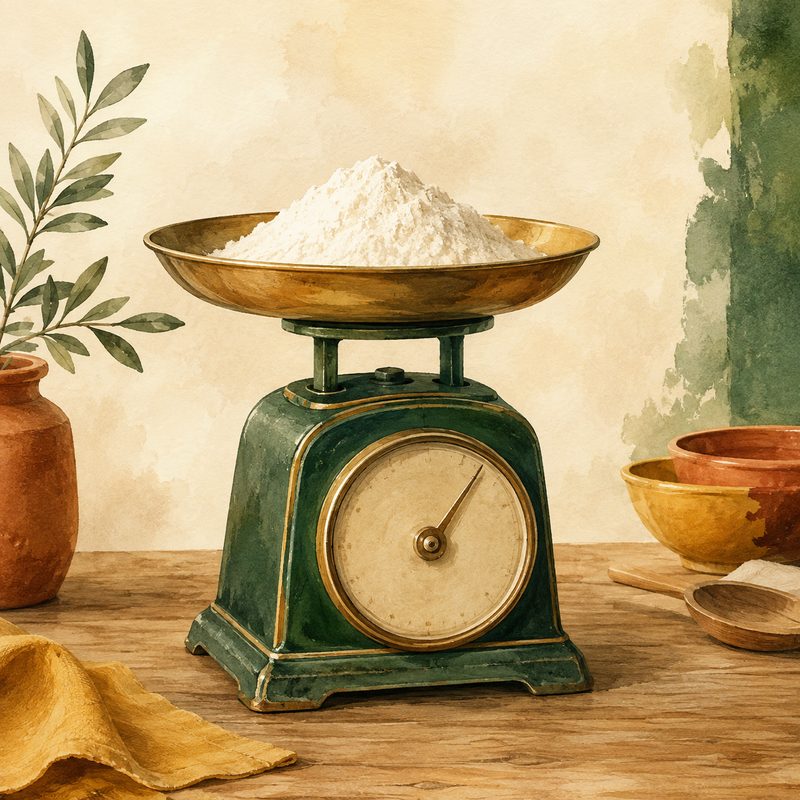
You're following an American recipe and it calls for "2 cups of flour." The obvious instinct: 1 cup = 250 ml, so 250 g. That's the most common mistake in baking — and the reason so many "translated" cakes come out dry and dense. The right answer: 1 cup of all-purpose flour ≈ 125 g.
Density changes everything
A cup is a measure of volume (250 ml in Canada, 240 ml in the US). But flour is light: it weighs only about 0.5 g per ml, because its very fine particles trap a huge amount of air. So for the same cup:
- 1 cup of all-purpose flour = about 125 g
- 1 cup of white sugar = 200 g
- 1 cup of butter = 227 g
- 1 cup of packed brown sugar = 220 g
Using 250 g of flour where the recipe wanted 125 g doubles the flour. No cake survives that. If you want to understand why two ingredients that fill the same cup weigh so differently, we've covered it in why a cup of flour doesn't weigh the same as a cup of sugar.
Cup fractions in grams
American recipes rarely call for round cups. Here are the equivalents for all-purpose flour, calculated with the same 0.5 density:
- 1 cup = 125 g
- ¾ cup = 94 g
- ⅔ cup = 83 g
- ½ cup = 63 g
- ⅓ cup = 42 g
- ¼ cup = 31 g
- 1 tbsp = 7.5 g (round to 8 g)
- 1 tsp = 2.5 g
For "2 ¼ cups," add them up: 250 g + 31 g = 281 g. The site's converter does this directly, including for quantities that don't land on a simple fraction.
How to measure correctly if you don't have a scale
The weight of a cup of flour depends enormously on how you fill it. Two people measuring "1 cup" with the same cup can get 125 g for one and 150 g for the other — a 20% gap, enough to change a cake's texture.
The method that lands closest to the 125 g reference, and the one nearly every American recipe assumes: fluff the flour in its bag with a spoon first, spoon it into the cup without packing, then level the top with the back of a knife. Never dip the cup straight into the bag: the motion compacts the flour, and that's exactly what produces the extra 25 g. Don't tap the cup on the counter to "settle" it either — that packs it too.
The rare recipes that specify "dip and sweep" assume packed, heavier flour — if you convert those to grams, count on 140 to 150 g per cup instead. It's an older convention you still find in some classic American cookbooks.
Sifted before or after measuring?
"1 cup sifted flour" and "1 cup flour, sifted" don't mean the same thing. In the first case, you sift first, then measure: the aerated flour takes up more space, so the cup holds less flour — around 110 to 115 g instead of 125 g. In the second, you measure the flour as-is, then sift it: the weight stays at 125 g, and the sifting only serves to remove lumps. The word order shifts the result by about ten grams; when in doubt, a scale settles the question.
Not all flours weigh the same
The 125 g figure is for white all-purpose flour, the most common in American recipes. Whole wheat flour, which is coarser, cake flour, which is finer, and almond flour, which is fattier and heavier, don't share the same density. The site's converter uses the density of all-purpose flour: for another type, the equivalent remains a reasonable approximation, but if the recipe is sensitive — a bread, a sponge cake — weigh rather than convert.
What actually happens when there's too much flour
Excess flour soaks up the recipe's liquid. The result is recognizable: cookies that don't spread and stay in a ball, a dense cake that crumbles, bread that's too tight, pancake batter that's too thick. On the flip side, too little flour gives cookies that spread into puddles and a cake that sinks in the middle. If your American recipes consistently fail in the same direction, the flour measurement is the first suspect — well ahead of the oven or the brand of butter.
When to keep using cups anyway
An American recipe was tested with cups, by someone who filled their cup a certain way. If you follow the spoon-and-level method described above, you'll get a result very close to the author's, no scale needed. Converting to grams isn't mandatory — it's mainly useful for repeatability: once you've found the right weight for a recipe, you'll hit it identically next time, which no cup can guarantee.
A scale remains the most reliable method — and our converter does the conversion based on the exact ingredient, not just the volume. Sugar, brown sugar, and butter each have their own article with detailed equivalents.
To go further: the complete conversion chart gives the same cup fractions for twelve ingredients, and the most common conversion mistakes show what concretely goes wrong when flour is measured badly.