Why a Cup of Flour Doesn't Weigh the Same as a Cup of Sugar
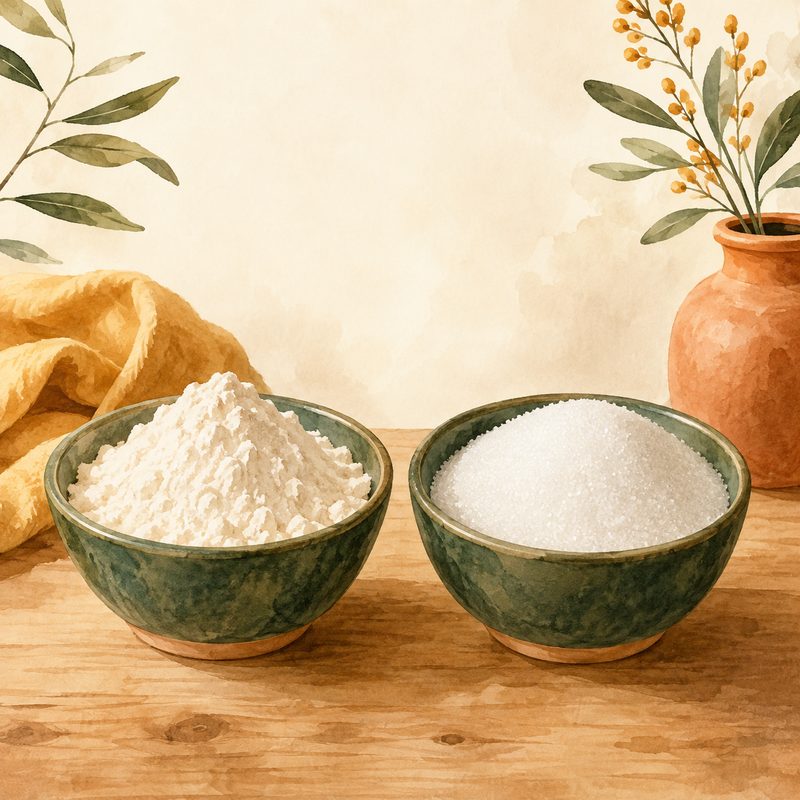
Because volume says nothing about weight. A cup of flour weighs about 125 g, a cup of sugar about 200 g — yet both fill exactly the same 250 ml cup. It's each ingredient's density that changes, not the cup.
Density, in one image
Picture a cup filled with feathers, then the same cup filled with gravel. Same volume, very different weight — the gravel packs more densely, with less air between the pieces. Flour and sugar follow the same logic, in a less extreme version: flour, made of very fine, irregular particles, traps a lot of air between them, while sugar crystals, more uniform, pack tighter against one another and leave less empty space.
Direct comparison, cup by cup
For the same 250 ml cup, here's what the most common recipe ingredients weigh:
- Oats: 90 g
- Cocoa powder: 100 g
- All-purpose flour: 125 g
- Powdered sugar: 120 g
- Rice: 195 g
- Granulated white sugar: 200 g
- Packed brown sugar: 220 g
- Butter: 227 g
- Honey: 355 g
- Water (reference): 250 g
The gap between flour and sugar — 75 g for the same cup — explains why you can never swap a weight for a volume from one ingredient to another, even when a recipe seems to give an "equivalent" hint. Honey, at the opposite end of the spectrum, weighs almost one and a half times more than the same volume of water: its thick, syrupy texture leaves very little air, unlike powders.
Why this genuinely matters in the kitchen
For sugar, the measuring error from using volume stays limited: the crystals are fairly uniform and pack down about the same no matter how you fill the cup. Flour, on the other hand, is much more sensitive to handling — spooning it in directly versus packing it down in the bag can swing its weight by 20% for the same apparent volume. That's why two people measuring "1 cup of flour" by the cup can end up with two different weights, while for sugar the gap will be minimal.
It's also why a professional recipe always states its quantities by weight rather than volume: weight doesn't lie, volume depends on how you fill the cup. Bakers even talk about "baker's percentage" — every quantity expressed as a percentage of the flour's weight — a system that simply wouldn't work if it were based on volumes.
If you have to measure by volume for lack of a scale, always spoon the flour into the cup without packing it, then level off with the back of a knife — that's the method closest to the 125 g reference.
What it means for substitutions
Density also explains why some "cup for cup" substitutions fail. Replacing 1 cup of sugar with 1 cup of honey, for instance, means putting 355 g of honey in place of 200 g of sugar — nearly double the weight, with extra liquid on top. Serious substitution guides actually give a lower ratio (around ¾ cup of honey for 1 cup of sugar) and suggest reducing the other liquids. Conversely, replacing all-purpose flour with almond flour at the same volume gives a much heavier, fattier batter. Whenever a substitution involves two ingredients of different densities, think in weight, or look for a tested substitution ratio — never cup for cup.
Try it at home
The best way to convince yourself: set an empty measuring cup on a scale, tare it, spoon in flour, note the weight. Empty it, repeat with sugar. Then a third time with flour, but dipping the cup into the bag and packing it. You'll get three numbers — around 125 g, 200 g, then 145 to 150 g — that sum up this whole article: the ingredient changes the weight, and so does the way you fill the cup. Once that reflex sets in, the scale becomes the obvious tool, and the converter serves to translate the recipes still written in cups.
The same principle applies to every dry ingredient
This logic doesn't stop at flour and sugar: every powder or grain has its own density, from cocoa to oats to salt. That's why converting a recipe by guesswork, swapping a weight for a volume without knowing the exact ingredient, remains the most common source of error in amateur baking — far more than the choice of proportions themselves.
The densities in this article, with cup fractions for each ingredient, are gathered in the complete conversion chart. And if the cup itself intrigues you — 237, 250, or 284 ml depending on the country — that's the subject of US cup vs imperial cup vs metric cup.