Fluid Ounce (fl oz) vs Ounce (oz), the Classic Mix-Up
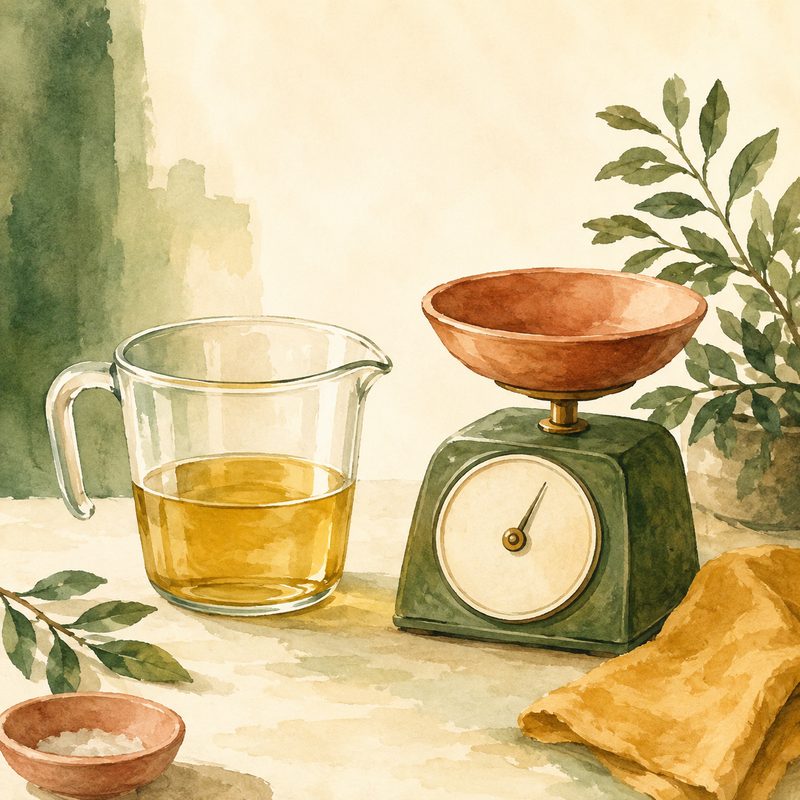
The fluid ounce (fl oz) measures a volume — 29.57 ml. The ounce on its own (oz) measures a weight — 28.35 g. The two happen to look similar for water, but become very different as soon as an ingredient doesn't share water's density.
Why the mix-up is so common
For water, whose density is 1, a fluid ounce weighs about 29.57 g — a figure very close to the 28.35 g of a weight ounce. The 4% gap often goes unnoticed, which is what makes people think "fluid ounce" and "ounce" are interchangeable. That approximation roughly holds for water, milk, or a light juice, but falls apart as soon as you're dealing with an ingredient that's denser or lighter.
Two examples that show the gap
- Honey (density 1.42): 1 fluid ounce of honey weighs about 42 g, well beyond the 28.35 g of a weight ounce. A recipe that calls for "1 oz of honey" and another that calls for "1 fl oz of honey" aren't talking about the same quantity.
- Oil (density 0.92): 1 fluid ounce of oil weighs about 27 g, a bit less than a weight ounce. The gap stays modest here, but it exists.
The further an ingredient's density strays from 1, the more the mix-up between the two ounces costs you in accuracy.
How to tell which one is being used
Context usually gives the answer away: "fl oz" or "fluid ounce" always signals a volume, used for liquids (milk, oil, extracts). "oz" alone, without the word fluid, signals a weight, used for both liquids and solids — an 8 oz package of cream cheese, for example, states a weight, not a volume, even though it's a spreadable product.
Quick reference
- 1 fl oz = 29.57 ml (volume)
- 1 oz = 28.35 g (weight)
- 8 fl oz ≈ 1 cup (volume)
- 8 oz = ½ lb (weight)
If an American recipe doesn't specify "fluid," check whether the ingredient is typically sold by weight (cheese, meat, chocolate) or by volume (milk, water, oil) to settle the question — that's often the best clue when the word "fluid" is missing.
Measuring cups marked in "oz" measure fluid ounces
The glass or plastic measuring cups sold in North America often carry an "oz" scale next to milliliters and cups. Those are fluid ounces — a volume — even when the label doesn't say "fl." They're perfectly suited to measuring 8 oz of milk or 4 oz of oil, but they'll never tell you what 8 oz of cream cheese or 6 oz of chocolate chips weigh: for that, only a scale gives the right answer. Trusting a cup's "oz" marks for a solid ingredient is a classic error that throws a recipe off by 20 to 40% depending on the ingredient's density.
Yogurt, sour cream, cream cheese: sold by weight, measured by volume
One category of ingredients keeps the confusion alive: thick dairy products. Cream cheese, sour cream, and yogurt are sold by weight ("8 oz," "500 g") but often measured by volume in recipes ("½ cup sour cream"). Since their density is close to water's, the gap between fluid ounce and weight ounce stays small — an 8 oz tub of sour cream fills about one cup — and the approximation is harmless in a dip or a cake. Cream cheese, denser and firmer, is the exception: better to weigh it, especially for a cheesecake.
If your kitchen scale displays ounces, switch it to grams for converted recipes: you'll avoid mixing weight ounces read on the scale with fluid ounces read on a cup.
The special case of baking recipes
In baking, where precision matters more than in savory cooking, professional recipes avoid the ambiguous ounce as much as possible, favoring either weight in grams or volume in milliliters, stated so there's no room for doubt. If you write your own recipes or adapt an American one to share, get in the habit of specifying "fl oz" whenever you mean volume — it saves the next person from asking themselves the same question you're asking today.
Keep this simple rule in mind: as soon as you see the word "fluid" or the abbreviation "fl" before "oz," it's a volume to convert to milliliters. Without that word, assume it's a weight to convert to grams — the safest assumption in the vast majority of recipes.
Our converter always applies the correct logic based on the unit you choose: select fl oz for a volume or oz for a weight, and the calculation runs automatically on the right basis, with no risk of mixing the two up.
This confusion is the fourth of the most common baking conversion mistakes; the US fluid ounce also differs slightly from the imperial one, as explained in US cup vs imperial cup vs metric cup.