US Cup vs Imperial Cup (UK) vs Metric Cup (Canada): What's the Difference?
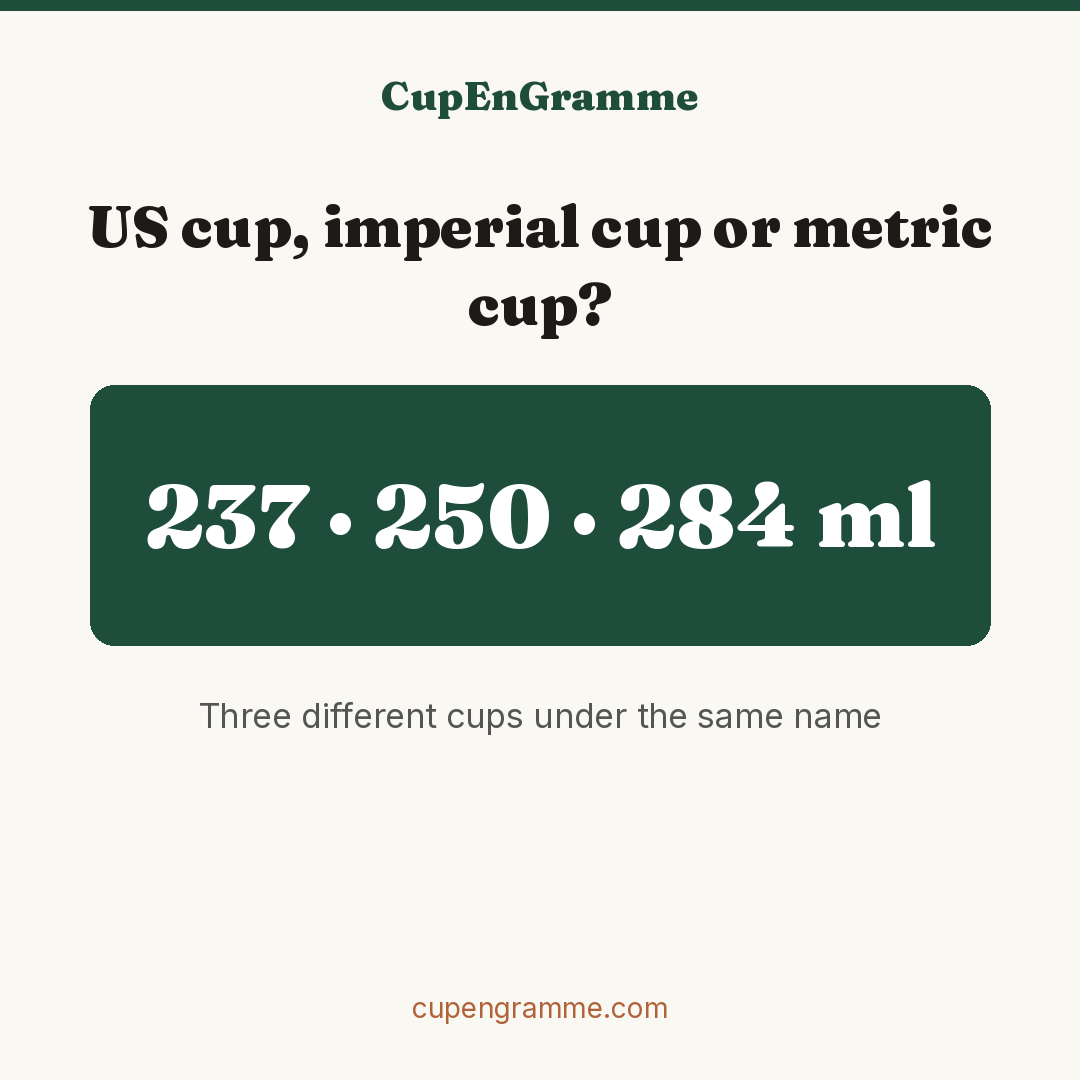
There isn't one cup, but at least three. The US cup is 237 ml, the metric cup used in Canada and Australia is 250 ml, and the British imperial cup is 284 ml. The same recipe written in cups can therefore represent quantities that vary by 20% depending on its country of origin — enough to ruin a cake if you land on the wrong case, even though, most of the time, the difference goes unnoticed.
The three cups, and where they come from
The US customary cup is defined as 8 US fluid ounces, or 236.59 ml — rounded to 237 ml. It's the cup of nearly every recipe published in the United States, from Betty Crocker cookbooks to today's food blogs. To complicate matters, US nutrition-labeling regulations use a "legal" cup rounded to 240 ml, which explains why you read sometimes 237, sometimes 240 ml for the "American cup": they're two roundings of the same measure, and the 3 ml gap has no consequence in the kitchen.
The metric cup is a more recent invention: when Canada, Australia, New Zealand, and South Africa went metric, they kept the habit of measuring by volume but rounded the cup to a round number, 250 ml — a quarter liter. It's the cup of the measuring cups sold in Canada, of Québécois recipes, and the one our converter uses.
The imperial cup is the historical cup of the United Kingdom: 10 imperial fluid ounces, or 284.13 ml — half an imperial pint of 568 ml. You'll find it in old British cookbooks and in some Commonwealth recipes from before the 1970s. Modern British recipes have all but abandoned it in favor of grams and milliliters, which makes it the rarest of the three today — but also the most treacherous, because its gap with the US cup reaches 20%.
For completeness, Japan uses a 200 ml cup in its recipes and on its rice cookers, and spoons have their own national variants too — more on that below.
Same word, three volumes: the gaps in numbers
- US cup: 237 ml (or 240 ml in the regulatory rounding)
- Metric cup: 250 ml — 5% more than the US cup
- Imperial cup: 284 ml — 20% more than the US cup, 14% more than the metric cup
The fluid ounce follows the same pattern: the US fluid ounce is 29.57 ml, the imperial one 28.41 ml. They're close, but a US pint holds 16 of these ounces while an imperial pint holds 20 — hence the British pint of 568 ml versus 473 ml for the American one. That story is detailed in our article on gallons, quarts and pints.
Why the converter uses 250 ml
CupEnGramme was first designed for cooks in Québec and Canada, whose measuring cups are graded at 250 ml. Converting an American recipe with the 250 ml cup instead of 237 ml introduces a 5% gap in a known direction (slightly more of every ingredient) that applies uniformly to the whole recipe: the proportions between ingredients stay identical, and that's what matters for texture. A cake with 5% more of everything is simply a cake that's 5% bigger.
If you want the precision of the US cup, the converter also accepts fluid ounces (8 fl oz = 237 ml): enter the quantity in fl oz rather than cups and you'll get the exact American value.
When the difference actually matters
In the vast majority of recipes, it doesn't: between 237 and 250 ml, the gap is smaller than the natural variation from how you fill the cup. Three situations are the exception.
Large quantities: in a recipe calling for 8 cups of liquid (a soup, a brine, a bread dough for several loaves), 5% amounts to 100 ml — and 20% with an imperial cup, nearly 400 ml. Convert those recipes to liters starting from the original cup.
Tight-ratio recipes: choux pastry, macarons, sourdough, crème anglaise. Where the liquid-to-flour or sugar-to-egg-white ratio determines success, it's better to weigh from the author's exact cup — or, simpler, to find a version of the recipe written in grams.
Mixed sources: an old British recipe adapted by an American blogger, or a family recipe copied across two countries. When you don't know which cup the author used, the recipe's internal consistency is the only compass — if the quantities look odd once converted, try the neighboring cup.
Recognizing which cup a recipe uses
A few reliable clues. A recipe that writes "ounces" for liquids, "sticks" for butter, "350°F" for the oven, and "all-purpose flour" is American: 237 ml cup. A recipe in French that speaks of "tasse," "cassonade," and gives temperatures in °C alongside cups is Québécois or Canadian: 250 ml. A recipe in "cups" with °C temperatures and ingredients like "caster sugar," "plain flour," or "self-raising flour" is Australian or New Zealander: 250 ml too, but beware, the Australian tablespoon is 20 ml instead of 15. A modern British recipe gives quantities in grams and milliliters — if there are cups, it's probably adapted from an American one.
Old British books (and some Irish or South African recipes from before metrication) are the only case where the 284 ml imperial cup is plausible; the clues are "gills," "pints" for milk, and a total absence of grams.
Spoons have their variants too
The teaspoon is thankfully universal at 5 ml. The tablespoon almost is: 15 ml in the US, Canada, the UK, and New Zealand, but 20 ml in Australia. An Australian recipe calling for 3 tablespoons therefore expects 60 ml, or 4 North American tablespoons — a 33% difference that shows in a sauce or a seasoning. The detailed tablespoon equivalents apply to the 15 ml spoon.
The real problem isn't the cup, it's the ingredient
Some perspective is in order: the gap between cups is 5 to 20%, but the gap between a packed cup of flour and an aerated one is 20% on its own, and the gap between a cup of flour and a cup of sugar is 60%. In other words, to get a converted recipe right, knowing the correct density of each ingredient and the right filling method matters far more than knowing whether the author's cup was 237 or 250 ml. The complete conversion chart gives those densities for twelve common ingredients, and the most common baking mistakes revisit what actually goes wrong in a conversion.
If you regularly cook recipes from several countries, the simplest solution remains a set of 250 ml measuring cups, a scale, and the habit of writing down successful recipes in grams: after a few months, the question of the cup stops coming up.