How Many Tablespoons Are in a Quarter Cup?
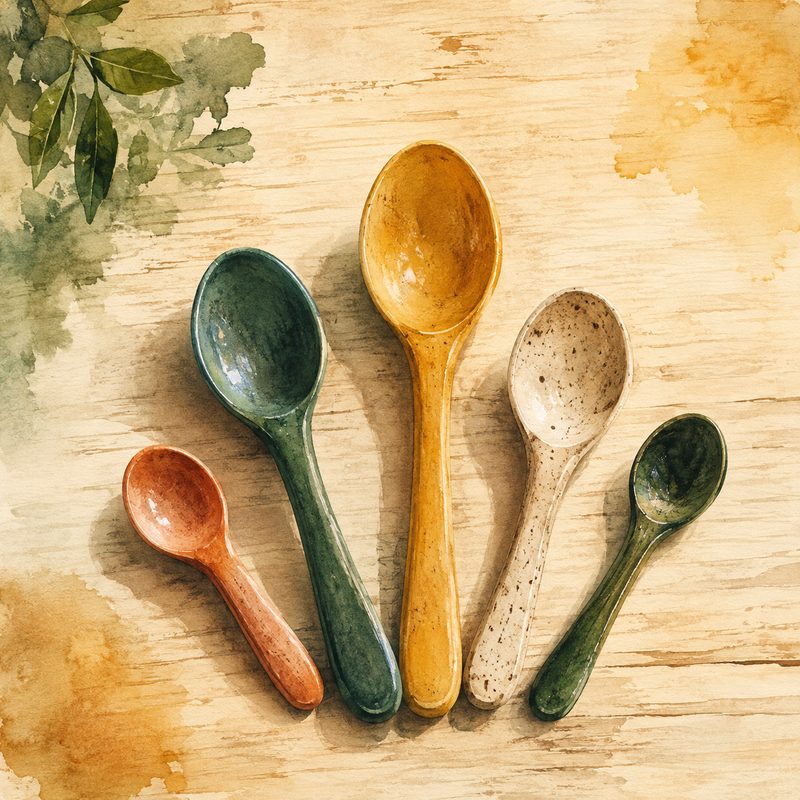
A quarter cup is 4 tablespoons — almost exactly. To land precisely on the mark, add half a teaspoon.
Where that small gap comes from
Our converter uses 250 ml for a cup, the standard value in Québécois cooking. A quarter of that cup is therefore 62.5 ml. A tablespoon, meanwhile, is a fixed 15 ml — a measurement that doesn't depend on the size of the cup. Four tablespoons therefore give you 60 ml, or 2.5 ml short of the 62.5 ml target. That gap equals half a teaspoon (5 ml), which is why "4 tbsp + ½ tsp" is the reference for an exact measurement.
In practice, that 2.5 ml difference changes nothing about how a recipe turns out — no one will notice the gap in a cake or a sauce. The 4-tablespoon rule of thumb is plenty for everyday cooking.
Other cup fractions in tablespoons
- ¼ cup = 4 tbsp (+ ½ tsp for exactness)
- ⅓ cup = 5 tbsp + 1 tsp
- ½ cup = 8 tbsp (+ 1 tsp)
- ¾ cup = 12 tbsp (+ 1 ½ tsp)
- 1 cup = 16 tbsp (+ ½ tsp)
Why use tablespoons instead of a cup
For small quantities — a sauce, a vinaigrette, a reduced glaze — measuring by the tablespoon is often more precise than a measuring cup, where a quarter-cup mark is hard to judge exactly by eye. It's also handy when all you have on hand is a set of spoons and no graduated cup: four heaping tablespoons stand in for a full measuring cup for most purposes.
A quarter cup in grams, by ingredient
Four tablespoons is a volume. If you'd rather weigh, the weight of a quarter cup depends on what's in it. With the densities our converter uses (for 62.5 ml):
- ¼ cup all-purpose flour ≈ 31 g
- ¼ cup white sugar = 50 g
- ¼ cup packed brown sugar = 55 g
- ¼ cup powdered sugar = 30 g
- ¼ cup butter ≈ 57 g (half a stick)
- ¼ cup oil ≈ 58 g
- ¼ cup honey or maple syrup ≈ 89 g
- ¼ cup cocoa powder = 25 g
- ¼ cup water or milk ≈ 63 g
The gap between honey (89 g) and cocoa (25 g) for the same measure shows why converting a quarter cup to grams "by feel" doesn't work: you need to know the ingredient.
Halving a recipe: fractions of a quarter cup
When you halve or quarter a recipe, you quickly land on fractions of a quarter cup that no measuring cup displays. That's where converting to spoons becomes essential:
- Half of ¼ cup = 2 tbsp
- A quarter of ¼ cup = 1 tbsp
- A third of ¼ cup ≈ 1 tbsp + 1 tsp
- ¼ cup + 2 tbsp = ⅜ cup (a common measure in halved recipes)
The same reasoning applies to ⅓ cup, which is trickier: half of it is 2 tbsp + 2 tsp, often rounded to 2 ½ tbsp in everyday cooking.
Converting the other way
If your recipe gives you a number of tablespoons and you'd rather use a graduated cup, do the reverse: divide the number of tablespoons by 4 to get quarter-cup units. Twelve tablespoons, for example, equal three-quarters of a cup — handy when an American recipe mixes both units in the same ingredient list, which happens more often than you'd think.
Our converter automatically calculates the combined-spoon equivalent (cups + tbsp + tsp) as soon as you enter a quantity in milliliters — useful for checking any cup fraction without doing the math by hand.
Always level spoons
These equivalents assume level spoons, leveled off with a knife — not heaping. A heaping tablespoon can easily hold 20 to 30% more than a level one for a dry ingredient like flour or sugar, which quickly throws off the calculation if you're relying on four spoonfuls to accurately reproduce a quarter cup. For a liquid, the level-versus-heaping distinction barely exists — the spoon naturally fills to the brim without excess, which makes measuring liquids by the spoon more reliable than measuring dry ingredients that way.
One last tip: if you're measuring a dry ingredient like flour by the spoon, scoop it into the spoon rather than dipping the spoon into the bag — the motion slightly changes the density you end up with, much like with a measuring cup.
Note that these equivalents hold for the 250 ml cup and the 15 ml spoon. The other cups (US at 237 ml, imperial at 284 ml) and the 20 ml Australian tablespoon are explained in US cup vs imperial cup vs metric cup.